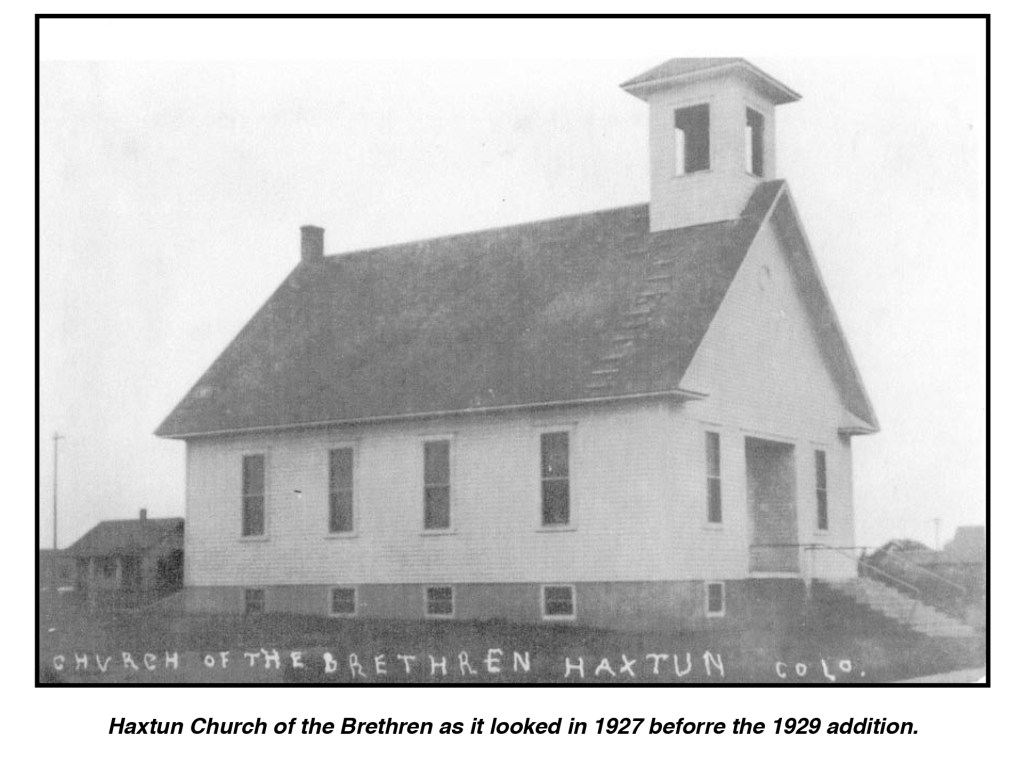
Haxtun Church of the Brethren Began as The Good Hope Congregation
Brethren homesteaders from Nebraska, Kansas and states further east brought their denomination to northeastern Colorado in the late 1880s. Although scattered over a large area that later became Sedgwick, Phillips, Yuma and Logan counties, these Brethren managed to hold services once a month or at least quarterly. The more remote met annually when a church deacon, traveling by wagon or horseback, visited.
The Brethren denomination, which holds the New Testament as its only creed, began when Alexander Mack of Schwarzenau, Germany started a movement melding Radical Pietist and Anabaptist ideas during the Protestant Reformation in 1708. The first churches, known as the “Dunkers” or the German Baptist Brethren, formed in the United States in 1923.
The Church of the Brethren, which represents the largest the largest body of Alexander Mack descendants and is one of three historical “peace churches,” along with the Mennonites and Quakers.
In June 1886, thirteen Brethren living in and around Haxtun organized the Good Hope congregation under the leadership of Elder John S. Snowberger, a member of the Northwest Kansas District. The membership in addition to Snowberger and his family included Allen B. and Nelson Van Dyke, Sara Furry, D.A. Fickel, Joel H. Kinzie, the Margin family and the Wagner family.
The church linked to the Brethren’s West Good Hope congregation in Sterling in 1908 and took the name East Good Hope Congregation. Elders D.B. Miller of Sterling and Joel H. Kinzie served as ministers with Lewis Hulse as assisting until 1913. The Nebraska District accepted the congregation in 1914 and the following year Elder S.G. Nikey took the pastor position, which he held until 1923.
During a district meeting in Octavia, Nebraska on Thursday, October 12, 1916, the name changed to the Haxtun Church of the Brethren.
R.P. Baker and his wife Nellie Baker, who earned second degree ministry in 1917, assisted Nikey with marriages, baptisms, communions and “Love Feasts,” a tradition of the Last Supper, which includes foot washing, a supper and communion. These ceremonies drew large crowds and on June 14, 1916, the congregation decided to construct Haxtun meeting place. The paid Mr. Sutherland $450 for land at the corner of Chase Street and Logan Avenue and formed a building committee.
Planners decided to construct a thirty-six- by forty-eight-foot building with a basement and belfry. The Haxtun Lumber Company supplied most of the materials at cost. Members donated time, labor and some materials. Ehud Bamford donated the bell. Total expenses reached $2,932 as the congregation prepared to dedicate the building on January 17, 1917.
Membership continued to grow and in 1926, the congregation decided the church needed more Sunday School Room. A committee made up of members Louis Koch, A.C. Heaston and F.H. Smith held two community sales that raised over $2,500 toward the cost of constructing a thirty-foot-square addition with a basement. They finished the entire basement, adding a kitchen and dinning room. The membership, which totaled two-hundred and thirty-five dedicated the new addition on January 21, 1929.
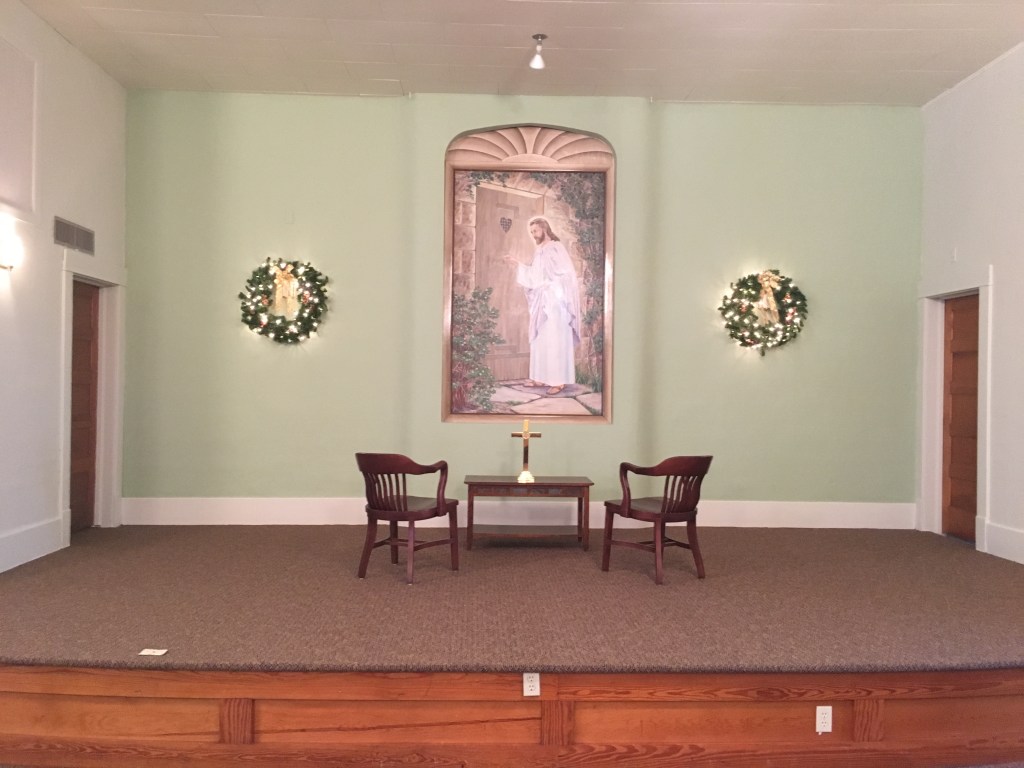
The church continues to welcome all who wish to come. Reminders of long-time member and artist, the late Jesse (Whitney) Scott, decorate the interior of the building, including a life-size oil of “Christ Knocking at the Hearts Door” that hangs behind the pulpit and stained-glass windows that depict the life of Christ.
 Haxtun Church Of The Brethren