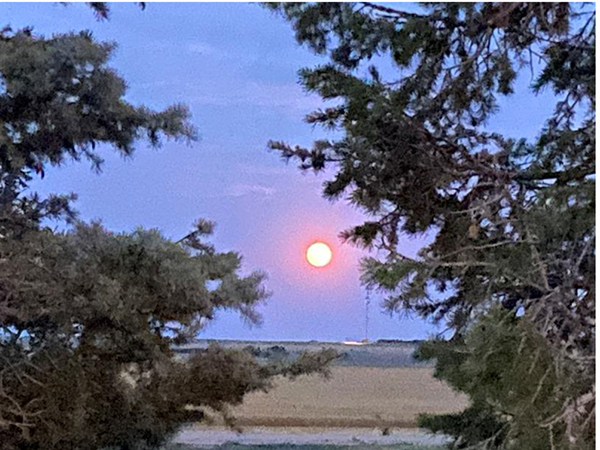
In recent conversations with a sibling, we both paused to admire the full moon as it rose in a glory of deep orange bordering on red. A true harvest moon. It was worth it to pause our dialog and simply take a moment to contemplate. What made it more special was the fact that we were four hundred miles apart as we regarded the same moon and its intentional rise to illuminate a beautiful evening sky. There was some comfort in having that as a touchstone in that moment.
According to many, the moon is literally a chip off the old block, composed largely of debris from earth. Several other theories suggest its origin is discoverable in the coalescence of gas and dust alongside earth. Perhaps the most favored theory is that two planetary bodies collided, giving rise to genesis for both earth and moon some four billion years ago. Regardless of origin, it has seemingly captured humanity’s affections in no small measure. Even leaving out the scientific explanation of all the moon does for us, its following among cultures is deeply noted. Tradition, superstition, and mythology all stake some degree of claim on the moon.
It appears rather simplistic to ask the question of how we knew we were looking at the same moon. Experience, education, intuition, and common sense led us in the right direction but the final conclusion resided with us. Two persons, two drastically different vantage points, and a conclusion we could agree upon. Sounds like a recipe for something theological.
When asked who or what has the final answer the retort is often “The Bible” or “Jesus.” Unless placed into the context of our own lives, it’s a stretch to say there is a source for all answers. While Jesus provided some answers to the questions he asked of his disciples, he was also adept at letting things settle a bit before offering conclusions. Could it be that we were meant to inquire and ask, bringing hard questions to the forefront, including having an occasional heart-to-heart with God? Consider the various perspectives it takes today in order to maintain an understanding of who we are societally and how we fit in the world of divine mystery.
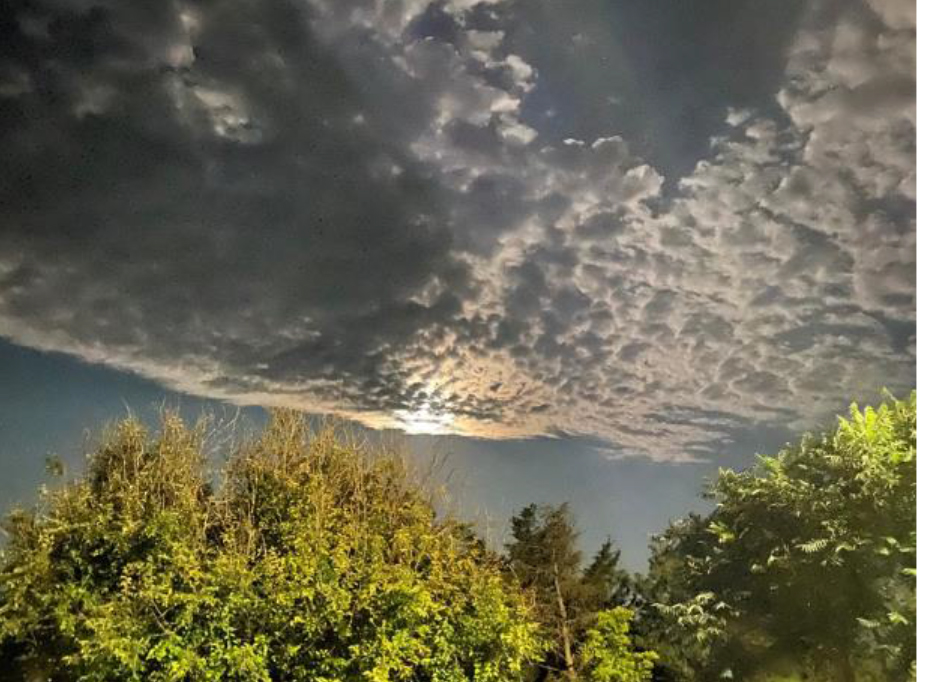
In the meantime, take a few minutes during the next full moon in order to appreciate how many views are present, all with their own particular vantage point. Can we begin to more deeply appreciate those perspectives?
Once we gain a perspective, we might still be faced with the difficult task of interpretation. In observing from our settings, my sibling and I could agree that we were both observing the same moon in the same moment. We never did resolve whether we observed a rabbit or a man in the moon. What about a woman in the moon? Told you it wasn’t easy. (kf)
 Haxtun Church Of The Brethren